
Keyword footprints are falling fast, and law firms are struggling to understand why. The March, May and August Google updates coincided with huge ranking losses across the legal cohort, causing marketeers to wonder if SEO really is dead. But the data tells us a different story.
Appius analysed organic search results across the last year for 14 leading law firms to see what was really going on. Between March and August 2026, the cohort went from 46,749 ranking keywords to just 14,308. That’s a 69.4% reduction in less than 6 months.
But legal marketeers don’t need to panic just yet. Over the exact same period, estimated organic traffic moved from 148,857 to 147,740. A barely noticeable drop of just 0.75%. What’s more, of the 14 firms we analysed 7 increased estimated traffic over the same period despite 13 of them losing keyword visibility.
How can almost 70% of search visibility disappear without the audience disappearing with it? In this study, we discover what’s really going on with SEO. The answer exposes one of the biggest problems with traditional SEO reporting.
Methodology
Appius analysed third-party estimated search data from Semrush across 14 UK legal/IP firms, not their private GA4 data. Organic ranking keywords are based on live clickstream data at the time of capture. Estimated traffic is assumed based on keyword search volume and average ranking position.
69% of the rankings disappeared. The traffic didn't.
This wasn't one law firm having a few bad months
The most telling insight from the data was law firms lost visibility in traditional search. But this drop in rankings wasn’t specific to a single organisation, legal niche or business size.
13 of the 14 firms, 93% of the cohort, had fewer ranking keywords in August than they had in March. This is a market pattern, not an SEO collapse.
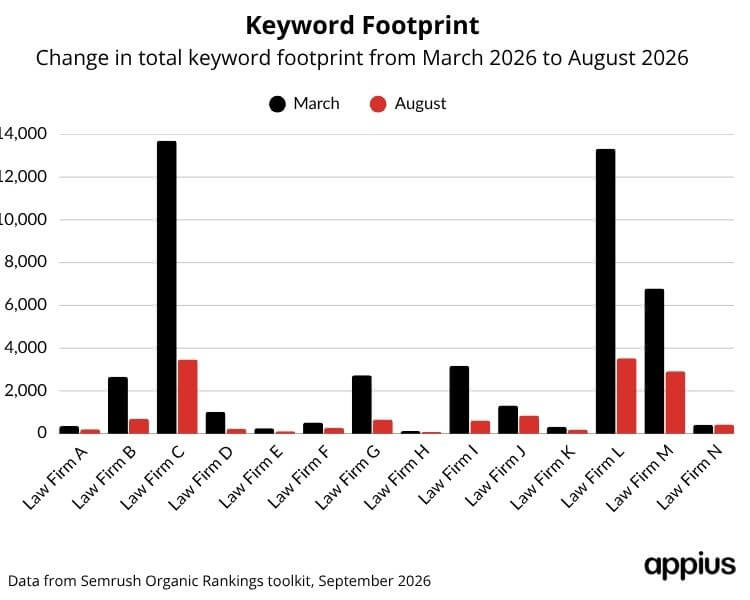
Across the board, the median firm-level keyword decline was 57%. The largest law firms in the set, that typically had a larger footprint to begin with, lost between 70%-80%+ of their total keyword visibility over this period.
Only one firm increased its total keyword count, with 2% more ranking keywords recorded in August than in March.
Legal marketeers looking at their own visibility graph would view this as an SEO problem. However, this is why relative visibility, or share of voice, is becoming increasingly important alongside the absolute numbers.
If virtually the whole competitive set is moving in the same direction, individual performance should be interpreted against the market.
Traffic tells a completely different story
When faced with keyword losses at this level, legal marketeers would be prompted to rethink their SEO strategies. Most likely, they’d be focussed on winning back those rankings and reclaiming their keyword footprints in the SERPs.
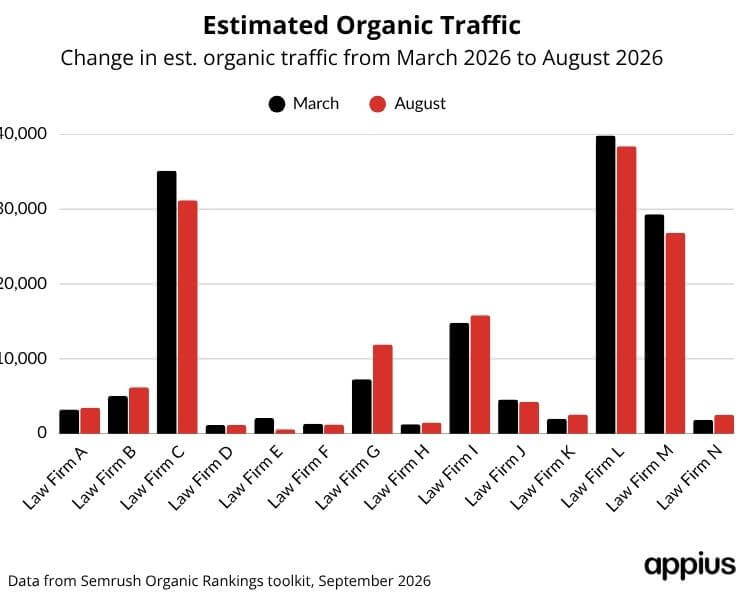
But looking at the bigger picture suggests that isn’t necessarily the best tactic. Despite visibility decline, aggregate estimated traffic fell less than 1%. Half of the law firms we analysed saw estimated organic traffic climb between March and August and the median firm-level change was approximately +3%.
Even isolating the 13 firms that lost keyword visibility, six still had estimated traffic increases. Keyword rank losses didn’t impact audience sizes, and whilst traffic itself isn’t the final commercial KPI either, it’s a much clearer indication of whether disappearing rankings matter.
Not all rankings are created equal
Google didn't remove 69% evenly across the search results
Semrush records all ranking keywords visible in clickstream data in positions 1-100. It’s when we start looking deeper into the SERPs that things get interesting.
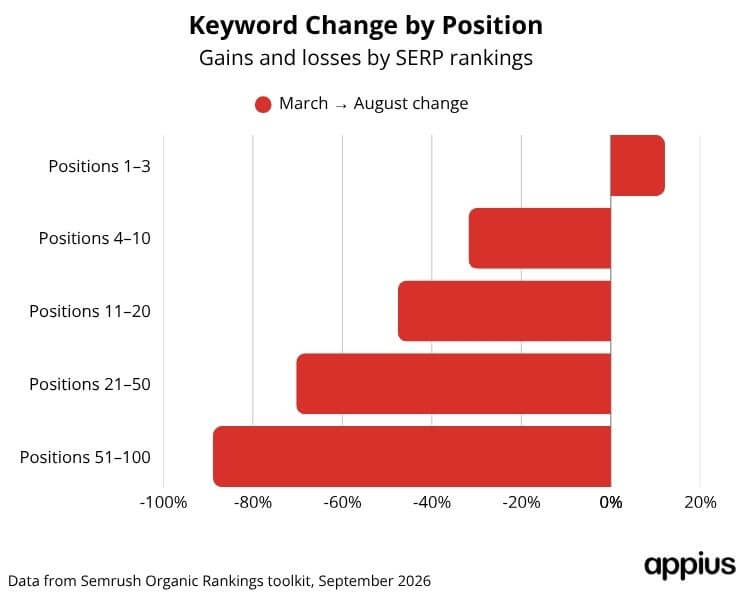
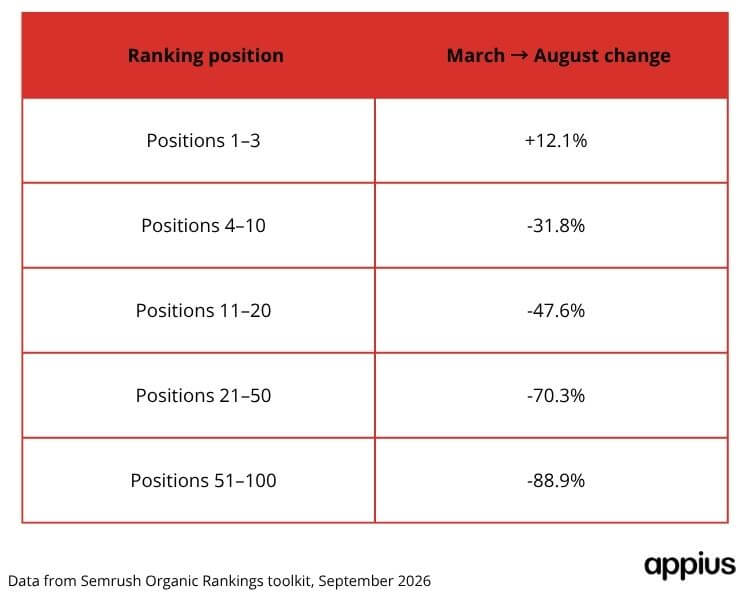
90% of keywords in position 50-100 disappeared from March to August 2026. Meanwhile, collectively the cohort ended the period with more position 1-3 keywords than they started with.
The first three organic ranking URLs earn up to 68% of all clicks. By the time the user scrolls to position 10, CTR has reduced to just 2.8%. Keywords ranking in position 20 onwards are unlikely to even drive search impressions on a law firms’ website. Commercially, these keyword rankings aren’t equal.
Losing 69% of organic keyword rankings in six months creates an alarming SEO graph. Realistically, the losses came from rankings nobody was clicking on and didn’t impact search demand reaching the site.
In fact, top-three visibility improved for 86% of firms
An old-school SEO strategy prioritised ranking high search volume keywords with demonstrated commercial intent in the top three positions. Once we started building E-E-A-T signals and topical authority into the mix, the strategy became broader.
Law firms had to expand their keyword footprint to capture more keywords related to a niche. This included search terms with informational intent or lower search volumes than original targets.
The purpose was to build topical authority, not necessarily drive organic traffic to informational content. In doing so, firms expanded their keyword footprint and the breadth of position rankings in search engine results. These are the keywords that have seen a visibility hit.
12 of the 14 law firms we analysed saw an increase in the number of keywords rankings in position 1 to 3. Collectively, this led to a 12% increase as absolute numbers grew from 1,038 to 1,164.
What this data shows is that while UK law firm search visibility has dropped, almost all of them became stronger at the top. Search footprint fell by 69%, but visibility in the top-three became 12% larger. Looking at keyword rankings alone is not nearly enough information to judge SEO performance.
One law firm lost 76% of its keywords and gained 64% more traffic
Three firms, three counterintuitive outcomes
We’ve been looking at the cohort collectively to understand what happened. Analysing firms individually helps us understand why this is happening.
Law Firm A: Lost three-quarters of its keyword footprint, increased estimated organic traffic by two-thirds
One of the law firms we analysed lost 75.7% of its keyword footprint in six months. The firm was mid-sized and specialised in commercial law with a strong intellectual property and technology focus.
Having a core focus is beneficial to law firms looking to grow or maintain their organic presence. In this example, the law firm already had hundreds of URLs and unique pieces of content published on its website about its niche. But it’s topical authority extended past its website, into digital PR, discussion forums and social media.
Despite the drop in overall keyword footprint, this law firm gained 32% more keywords in the top-three rankings because Google recognised it as a credible firm on its chosen subject. That growth increased estimated organic traffic by 64%.
Law Firm B: Increased top-three ranking keyword coverage, barely moved the needle in estimated organic search traffic
Another law firm lost over 80% of its ranking keywords and, despite a 76% increase in top-three ranking positions, only increased estimated organic traffic by 6.7%. This is completely different to the example above and proves one very valuable point.
Traditional SEO strategy, focussed on prioritising keywords with the right intent and good search volume, is still key to organic traffic growth. Where this firm managed to capture more high ranking positions, the estimated organic traffic didn’t increase in parallel. This may have been caused by:
· Rankings improved for keywords with low search volume, so visibility and demand didn’t grow alongside the gains
· Rankings improved for keywords with strong informational intent, that likely served an AI Overview in position 1 reducing CTR to below 1%
Law Firm C: Barely moved top-three rankings, but estimated traffic climbed 29%
On the opposite side of the spectrum, law firm C (a specialist IP firm) gained almost 30% more estimated traffic with just a 5% increase in top-three rankings. Like we have witnessed across the cohort, the majority of these loses came from keywords that were ranked position 51-100. These had very little impact on performance metrics.
Law firm C maintained its presence in the top-three at a steady rate but saw a substantial estimated traffic uplift. This tells us that even top-three keyword count is an imperfect KPI to track for SEO results. Search volume, query intent and AI Overview presence all play a factor into whether or not the page will ever get clicked on. In this law firms case, it did.
Three law firms, three different stories. But all of them started with a massive visibility decline. If these firms had reported on total ranking keywords alone, all their SEO dashboards would have been in the red.
Looking at what actually happened on the search engine results pages gave a very different insight. Estimated organic traffic gains recorded across all three firms, with more keywords in the prime top-three positions. This shows us that not all keyword positions should be seen as equal, performance should be evaluated on what was lost instead of absolute numbers.
However, not all gains were weighted equally either. Firm C gained almost 30% in estimated traffic over the six months with a relatively small increase in top-three rankings. Meanwhile firm B, who had a 75% increase in keywords ranking in position 1-3, only had a 6.7% increase in estimated organic traffic.
This is particularly important for law firms looking to generate leads from organic search traffic. It shows us that relatively small numbers of commercially important searches can be substantially more valuable than thousands of peripheral informational rankings.
But sometimes a visibility decline really is a problem
One law firm lost 56.7% of its ranking keywords between March and August, but unlike the rest of the cohort, top-three rankings and estimated traffic also fell.
This law firm saw improvements in off-page authority signals over the same period, including a 19% increase in backlinks and an increase in AI Visibility score. What actually happened was more worrying than a simple keyword purge.
The law firm lost the position 1 ranking for their brand name, taking almost all the estimated traffic with it and highlighting another SEO issue law firms face - weak non-brand search foundations.
Summary:
These examples show that data alone can’t tell you why something happened. Whilst it’s important to analyse the whole market, sometimes something as simple as losing the rank for your brand name can cost most of your organic search traffic.
We can’t ignore falling keyword footprints just because it’s happening to everyone. At the same time, the absolute numbers don’t tell us enough of the story to know when we need to act. Individual site performance, combined with market data, enables law firms to diagnose what’s happening and prioritise what to fix.
So why did law firms suddenly lose so many rankings?
The dataset shows us what happened but doesn’t tell us why. Our Experience & Insights team stay up to date with all things SEO and GEO and have filled in some of the blanks.
Search engines don't owe every page an indexed ranking
Google have been very vocal about prioritising quality over quantity. The 2025 update of the Search Quality Evaluator Guidelines contained the word ‘effort’ 120 times. That’s a 314% increase since the 2020 version, which contained the word only 29 times.
The role of a Search Quality Evaluator is to judge whether a page satisfies users by assessing helpfulness, quality, trustworthiness, relevance and expertise. Whilst the scores provided by 16,000 independent reviewers don’t influence page rankings, they are used to train crawlers in future algorithm updates.
With AI in the mix, it’s easier than ever to create content on mass. But generative AI tools like ChatGPT and Claude can only synthesise answers based on what already exists. It’s becoming increasingly difficult to gain sustainable visibility with repetitive or undifferentiated content. In March 2026, Google ramped up efforts to remove pages from its index that didn’t add value to the internet.
Legal websites are particularly susceptible to this. Many law firms publish large volumes of legislative updates, near-identical event/news content, broad legal explainers and thin practice-area material.
Based on the data, it could be related to Google’s index purge. A decline is high ranking keywords with little impact on estimated traffic is exactly what we’d expect to see from the removal of low-quality pages. We can’t state this as fact without getting under the bonnet of each of the sites, reviewing GA4 and Google Search Console insights before and after the March update.
Summary:
Any good SEO should be implementing E-E-A-T strategies, adding expertise and developing strategic content strategies. Building topical authority involves expanding the number of ranking keywords covering a subject matter. This has created huge, long-tail footprints, although isn’t likely to be generating any meaningful traffic.
Topical depth is still important to build authority and gain visibility in AI and traditional search. However, for law firms, publishing another generic 700-word explainer isn’t going to add expertise to the internet. Especially if other legal sites are saying exactly the same thing.
Google is looking for quality. The Search Quality Evaluators are looking for effort. Before legal marketeers and content managers publish anything, they should be asking whether this page adds something that only their firm, lawyer or dataset can credibly contribute.
The legal sector has been measuring SEO backwards
A bigger keyword footprint isn't necessarily a better one
One thing we can positively say from this data is that a bigger keyword footprint isn’t necessarily a better one for law firms. Raw keyword count rewards all ranking keywords equally, without considering visibility, relevance or commercial value.
Not only can this look like an SEO disaster when things go wrong, but on the other end of the spectrum it can encourage marketeers and content teams to chase those position 50+ rankings.
This data shows us how quickly those numbers can vanish. But also, how little impact those numbers have on overall traffic estimates.
What legal marketeers should focus on instead
Rather than counting keywords in the top 100 positions, law firms and legal marketeers should prioritise:
· search footprint
· search visibility
· commercial search footprint
Keyword footprint alone can’t explain what’s happening. A better metric is search footprint, or visibility across the SERP results, AI answers and SERP features. Commercial visibility should be treated as equally important, as it separates the vanity metrics from the results that drive conversions.
Start with topics, not thousands of individual keywords
The firms that saw the highest growth in this data were firms with a specialised niche – despite a significant reduction in their keyword footprint. Meanwhile firms with varied global expertise also lost keyword footprint, but didn’t get the same level of growth in estimated traffic. That tells us Google is homing in on topical experts.
Law firms looking to succeed in 2027 should stop prioritising massive keyword footprints and start building topical coverage. Target topics, not just keywords and track visibility by topical clusters that align with the firm’s commercial strategy.
What should law firms measure instead?
Stop putting total ranking keywords at the top of the report. This is a given, considering everything this article has covered so far. Keyword footprint alone doesn’t tell you anything about how a law firm is performing in organic search.
Commercial outcomes
Instead of ranking keywords, start with commercial outcomes. This is the data that proves ROI and can get stakeholders on board with SEO, PPC and digital marketing efforts. Focus on enquiries or leads, qualified conversions and matters influenced.
Qualified organic traffic
Once commercial outcomes have been proven, showcase the warm leads that have landed on a strategic service, sector or expertise page. Whilst they may not have converted, they are now familiar with a service your law firm offers and more likely to come back later.
Top-three and top-ten visibility
These are the metrics to track if your goal is to grow organic search and AI visibility. As this study shows, increasing the number of top-three ranking keywords leads to more organic traffic. But it also shows where a law firms expertise lies.
This is where topical authority comes into play. A law firm that already has 15 top-three ranking keywords related to employment legal services is more likely to achieve new or improved keyword rankings for content related to that topic. Track keyword positions, but keep an eye on the topics that appear most often to understand where strengths and weaknesses currently sit.
Non-branded visibility
Tracking impressions and clicks on Google Search Console gives an overview of visibility. But breaking that down into branded and non-branded visibility shows whether a new audience can discover you, or you’re relying on reputation to close the deal. Improvements in non-branded keyword positions, impressions and clicks shows an SEO strategy is working.
Note: Brand visibility is important. Growing brand search volume indicates stronger performance other across other channels, such as LLMs and social media, that historically have been hard to measure.
Engagement with expertise
Traditionally, SEOs had one job: get people onto the page. Today, Google uses engagement metrics to assess page quality. That means users must stay and engage with page content after they land. GA4 data shows engagement metrics such as average time per session and engagement rate but can also map page paths and see which pages users land on prior to converting.
Competitive share
Potentially the most important metric to track is competitive or market share of voice. This entire study shows what can happen if you look at your numbers in isolation vs comparing results across the market. Tracking competitive share tells you if your visibility decline was caused by a loss of coverage, or if Google just changed the rules again and everyone’s results have shifted.
Everything else
Organic traffic and SEO performance is just a small wedge in the massive pie that is the way users search today. Reporting on these metrics alone can tell part of the story. But what it really comes down to is visibility across all digital touchpoints.
Digital marketing teams should not be fragmented across paid, organic search, AI visibility, social, digital PR and email. AI citations, brand mentions, PR coverage, expert visibility and social distribution increasingly belong in the same conversation.
To truly become the law firm users turn to, legal marketeers should optimise to become part of the conversation… wherever that conversation is happening.
And no, a falling SEO graph doesn't automatically mean you need a new website
It’s easy to blame a website for falling SEO results. Old infrastructure and historic content could be having an impact on visibility, but it’s not often the route of the problem. As this study has shown, loss of keyword visibility wasn’t isolated to one law firm. It was market wide, effecting law firms whether its website was built on WordPress, Sitecore or another CMS.
Diagnose the constraint before prescribing the solution
Whilst the website might be contributing to the problem, it’s unlikely to be the only cause. Traditional search visibility decline could come from:
-
poor technical foundations
-
poor crawlability or indexation issues
-
weak or thin content
-
poor information architecture
-
an undifferentiated proposition
-
ineffective internal linking
-
declining brand relevance
-
Google algorithm changes
Sometimes, just one of these factors is enough to see massive shifts in visibility. But more often than not, it’s a combination of some/all the above. That isn’t a strong case of a new website. That’s a strong case to revisit the basics of SEO.
If the existing platform prevents a firm from fixing these problems or scaling its visibility, then a rebuild can be justified. But without fixing the above, it won’t matter how up to date a website is – visibility can’t scale with poor SEO implementation.
That’s why law firms struggling to remain relevant in 2026 should start with an audit. Understand what’s changing and how that compares to the market trends. Build upon strengths. Fix weaknesses. Define what good looks like and what exactly is needed to achieve that.
Then, and only then, should a new website become part of the discussion.
The real question isn't “how many keywords do we rank for?”
To recap, law firms lost 69% of ranking keywords between March 2026 and August 2026. With that decline, a measly drop of 0.75% of total estimated traffic and 12% more top-three ranking keywords.
Those results describe the same group of websites over the same six month period. But if any of the law firms looked at its results in isolation, they would have completely different board-level interpretations.
It’s time SEO reporting matured beyond position rankings.
For law firms, success should mean becoming more visible to the right audience, for the right subjects, in the places that influence consideration. The objective has shifted. It’s not to rank for the largest possible number of keywords. It’s to be found when being found matters.
The legal sector hasn't lost 69% of its audience. It may simply be losing 69% of the search visibility that wasn't doing very much in the first place.
You might also like