Having worked on SEO in agency environments and client side for the last 12 years, there is only one thing I know for sure. Google rewards effort. Your shortcut, or that “SEO hack” your position tracking tool told you to take advantage of is a quick win that will cost you big time in the future.
We’re all using ChatGPT, CoPilot, Gemini and Google’s AI Mode to complete basic tasks. It is no surprise AI-generated content is on the rise. Will Slater from 43 Clicks North predicts AI created over 50% of the internet.
Scary, right?
The dawn of AI-generated content
ChatGPT was opened to the public in October 2022.
At first, along with most of the digital marketing world, I thought life was about to get easier. Why sift through Google results when ChatGPT can do the research for you?
But let’s be honest, we weren’t just using large language models (LLMs) for research. Social media captions, YouTube video transcripts, blog posts, marketing emails, landing page copy. You name it, ChatGPT wrote it.
And then everyone started sounding the same.
On a personal level, I began to despise the monotony of the content I was being served. Everyone had the same voice, whether a brand or a person. That’s when I started thinking maybe this AI-generated content thing isn’t all it’s cracked up to be… And I wasn’t alone.
Today’s consumer is 52% less likely to engage with AI-generated content. Less than a third of people share any positive sentiment towards AI, no matter whether on social media, website or chatbot.
Those stats tell us everything we need to know about using AI-generated content across your channels. Customers don’t like it. But can they tell?
Can users detect AI-generated content?
It’s all very well stating users prefer human written to AI-generated content, but can they tell the difference? One study, published in the International Journal for Educational Integrity, suggests they can. With participants correctly identifying content generated by ChatGPT up to 70% of the time.
We’re talking about advanced machine learning models here, so things change quickly. A more recent study, published in the National Library of Medicine, found 66.7% of people correctly identified AI-generated content. This study focusses on healthcare publishing, where trust and expertise are expected from every author.
So yes, users can tell the difference between human written and AI-generated content. Furthermore, they are actively choosing to be less engaged when they come across it.
AI-generation for SEO
Put a finger down if you’ve ever had a digital marketing expert tell you AI can do your SEO for you. Use the tools to streamline some of the processes (be careful what data you enter into free models). But don’t, under any circumstances, replace human written content with generative AI. Your customers don’t like AI-generated website content, and they can tell when it’s not human written. Furthermore, Google is rewarding human written sites in organic search.
Semrush analysed 42,000 blog posts to find out whether Google preferred human-written or AI-generated content. Using an AI detector to grade the posts, Semrush concluded human-written content was 8x more likely to achieve a position 1 ranking on SERPs than anything AI-generated. Content classified as fully human-written outperformed content classified as AI-generated or a mix of both in all Top 10 SERP positions.
This wasn’t the only experiment that proved Google prefers human-written content. Rankability agreed that, whilst Google states they don’t penalise AI-generated content, you are 83% more likely to achieve a top SERP position if you write it yourself. Their study followed a similar methodology, using an AI detector (Originality.ai) to detect the AI percentage of the pages that ranked for the most competitive keywords – spanning blogs, services, and localised business pages.
Both Semrush and Rankability have been able to prove what SEOs have known from the start. Google rewards high-quality content that provides genuine value to the audience. Generative engines can’t do that, and it’s hurting your rankings.
Still don't believe me? Take a look at what Google's John Mueller told Stu back at BrightonSEO in 2024...
Are we getting used to AI-generated content?
Is there a world where we just get used to AI-generated content? I can’t say with certainty, but the research suggests we won’t.
Due to the scalability of AI-generated content, we’ve been heavily exposed to it since launch. Analysing various studies, including the two listed above, shows our ability to detect AI-generated content is as strong as ever. These findings span across various user profiles, whether it’s the everyday reader or with deep academic roots.
Not only that, but media channels have started flagging content as AI-generated. LinkedIn, Instagram, Facebook and TikTok are all using badges to add disclaimers to posts that were created by AI (whether you ask them to or not). And it won’t stop at social media.
This means, even when humans can no longer distinguish between AI-generated content and human written, the technology will do the work for them.
Let’s not forget that organisations and agencies alike are racing to hire content humanisers. This role first appeared late 2023, following the launch of ChatGPT. Not only is there huge demand today, but these writers are starting at an average salary of £29,000-£50,000. Compare that to content writers (earning an average of £29,000-£30,000) and you see the motivation. Everyone is removing AI-generated content, and they’re doing it now.
So what can you do about it?
The HUMN-1 Certification
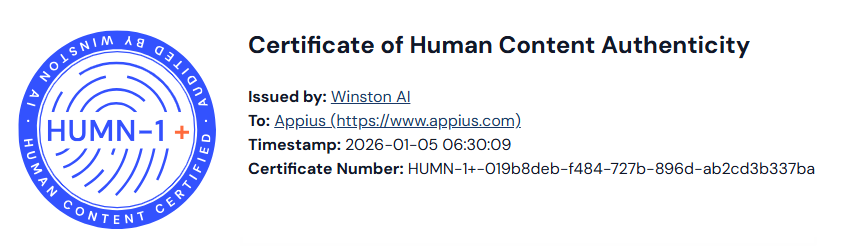
Earlier this year, Appius received the HUMN-1 Certification from Winston AI. This accreditation acknowledges Appius.com being created and written by real humans. Alongside AI policy, the HUMN-1 Certification is becoming essential to build trust with your audience and prove your expertise in any given field.
Winston AI detector is the most trusted AI detector globally. It’s used by organisations and SEO agencies, who rely on Winston AI to scan written content and images. The tool provides a human generated likelihood, with a low score indicating a significant likeliness it was created by AI.
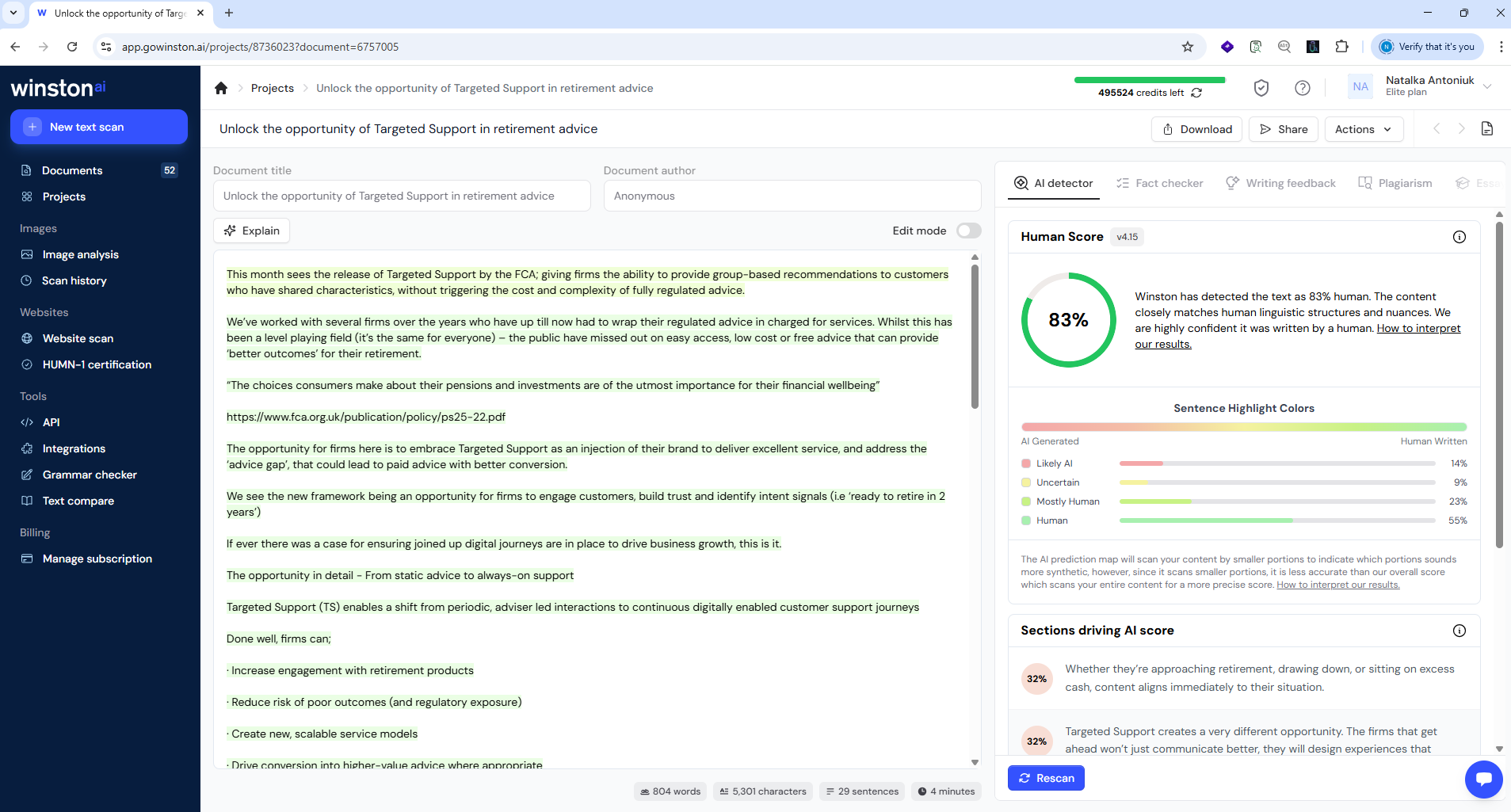
The grade detection suite flags AI-generated text with accuracy and has been adopted by the education industry for its optimal integrity.
How Winston AI detects AI-generated content
Winston AI detects AI-generated content by:
- Analysing patterns
- Measuring text predictability
- Assessing sentence structure variation
- Identifying high-probability word sequences
Human writing is messy (especially mine). When an LLM creates content, it’s smooth and streamlined. There are patterns in both sentence and paragraph structure, and the same phrases repeated across the web.
Seriously, I’m looking at two pages of Google news results published in the last 24 hours that feature the phrase ‘In the ever-evolving landscape…’.
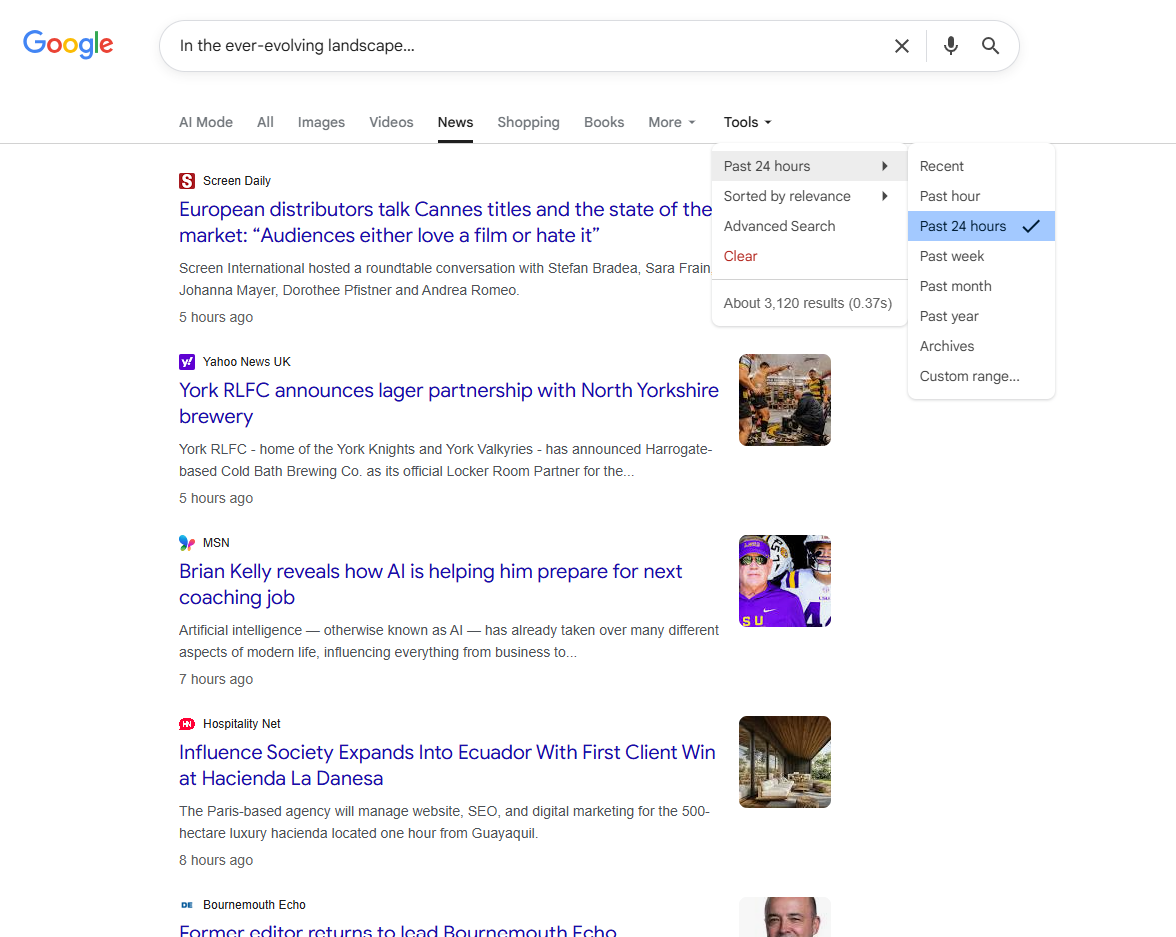
Can I guarantee these were AI-generated? No. Did I scan them on Winston AI to check? Absolutely:
| Page | Human Likeliness Score |
| Gen-X Biz Whiz: Secrets of Business Magnates | 0% |
| Nature’s Twist in Motion: Unravelling Time-Evolving Helicity in Polymers | 0% |
| Market Sentiment Pulse – A brief update on what’s moving markets and why – April 28, 2026 | 0% |
| Drone Battery Market Accelerates with Lithium-Based Dominance, AI Battery Management Systems, and Commercial UAV Expansion, Projected to Reach USD 30.9 Billion by 2035 | 0% |
| Global Drone Aerial Dropper Market to Witness Rapid Expansion Through 2032 | Regional Progression, Leading Manufacturers & Predictive Forecast 2026-2032 | 53% |
| Deadly Immune Desert in CCNE1-Driven Gastric Cancer | 0% |
| Global Drone Payload Release System Market to Witness Accelerated Growth Through 2032 | Current Trends, Emerging Opportunities And Industry Forecast 2026-2032 | 52% |
| Adding Dermal Absorption to Toxicokinetic Modelling | 0% |
This is a great example showing how AI-detectors like Winston AI can tell whether a piece of content is human written. But it’s only one of the processes that the tech uses to assess.
The Human Score estimates the likelihood that the content was generated by an AI tool like ChatGPT instead of being human written. 80% human and 20% AI doesn't mean that only 20% of the content was generated by AI; rather, it means that there is a 80% confidence level that the content was created by a human.
Winston AI is not the only AI detection tool available. QuillBot, GPTZero and Grammarly are some other popular tools that professionals use to assess whether written content was created by AI or a human.
However, Winston AI is widely accepted to be the most trusted detector available. This is because it offers features such as:
Largest human sample
The creators trained Winston AI on large datasets of academic writing samples. This minimised a false positive caused by flagging grammatical accuracy as being AI-generated.
High accuracy
Winston AI remains ones of the most accurate detection tools. Even with updates like GPT-4 and Claude, Winston AI can detect AI-generated content with up to 99.98% accuracy.
Always learning, always up to date
ChatGPT opened the door for Large Language Models (LLMs). Whilst still the most used, competition is coming thick and fast. And, like humans, each LLM has a unique writing style. Winston AI is trained on the largest datasets, including newer LLMs, to ensure accuracy across every generative engine.
What you should do now
Here’s what we know from this article so far:
- Your customers prefer human written content and are less likely to engage when you use AI to create website copy, social media posts or marketing content.
- Users can detect AI generated content with up to 70% accuracy.
- Google is more likely to rank human written content.
- There is a growing demand for ‘AI humanizers’, who are getting paid up to 72% more than standard content writers to fix AI-generated content.
- AI detectors like Winston AI can detect AI-generated content with up to 99.98% accuracy.
- Social media is already using this type of technology to flag AI-generated content to its users, and it’s not long before we see this in search.
If you have been using AI to create your content, you’re not alone. This landscape is changing so quickly. It wasn’t even a year ago we were getting recommended tools that did exactly this.
Today, we have the data and understand the impact AI-generated content is having on our search visibility and user experience. This is exactly what I would do if I was responsible for a website today:
Scan your entire website
One of the great things about Winston AI is the ability to upload a sitemap and scan every URL at once. Each page is given a human score so it’s easy to prioritise next steps.
Humanize AI-generated content
If you have any pages flagging as AI-generated content, begin humanizing starting with the highest priority. Add real lived experiences, case studies and a storytelling narrative that distinguishes your page from anything an LLM could create.
Create an AI policy
Often organisations have multiple content writers and editors. From our experience, they’re likely following different processes entirely. Creating a solid AI policy is an easy way to keep everyone in line with the direction you’re going in. If you are using AI systems (LLMs, chatbots etc.) you should already have this in line with the EU AI Act & UK GDPR.
Final Thoughts
Humanizing your entire website is a daunting project to start. But in today’s environment, can you afford to delay?
That’s what Appius is here for. With our elite level Winston AI access, we can scan your website for you and provide a prioritised list of pages to humanize.
Our Engagement & Insights team includes UX and SEO content experts that are on hand to support with creating content that not only ranks in Google and gets mentioned by LLMs but draws users in and improves your digital customer journeys.
If you want to see how your website performs, get in touch.

You might also like