Here we are again fresh from another insightful Brighton SEO conference and literally just exiting another major Google core update. So, what have we learned, how has the world of search changed in 6 months and what will we/should we be doing differently as we navigate the rest of 2026?
Well for starters I’m pleased to say that many of the talks we attended (divide and conquer is the Appius motto at Brighton SEO so we can absorb as much information as possible), affirmed the methods we’ve been using to deliver our client SEO strategies over the last 12-18 months.
This time the hero conference had the PPC series of talks as part of the programme, which right now is becoming super-relevant: if your PPC and SEO teams are not working as one still, time to take a step back and ask why. With SERPs now full of so many different formats, more often than not you need PPC to even be visible.
One of Theresa’s key takeaways from Hero Conf was in an AI-influenced search landscape, focussing on ROAS, CPA and end conversions can mean missing the bigger picture. Read her guide to PPC in the AI era here.
But of course, it’s not all about SERPs anymore. It’s now all about discovery and “Entity SEO” being the new buzzword. Let us dissect the information in our usual format: the “scary”, the “get real” and the “progressive” learnings.
Scary SEO Insights
It’s no surprise we’re still talking about the scary side of SEO. The May/June Core Update was extremely volatile, with many sites losing visibility overnight. AI is still stealing clicks. And Google is finding even more mischievous ways to siphon your organic search traffic into their AI Mode. That’s not the worst of it though.
Here are the three scariest SEO insights we picked up from BrightonSEO.
1. Your Content is Getting Wiped From the Index
Your carefully crafted pages may not get ranked AT ALL anymore. Google has been telling us for some time now that its core updates are all about surfacing “helpful content”. The most recent core updates have been getting pretty brutal, removing pages from the SERPs if the content is deemed too generic.
Check if you were affected by this algorithm update by looking at your indexed pages in Google Search Console. Where you see a rise in ‘Crawled – Not Indexed’ pages, that means Google has seen your content and actively decided it’s not worth adding to the index or serving in search results.
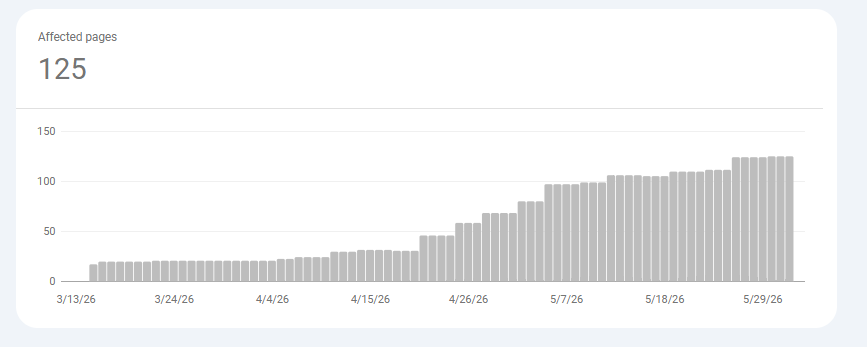
One of the main reasons for this change is the rise in AI generated content. Corinne Card from Full Story Media said at least half of all the new articles published daily are created by AI. And users have had enough of AI slop. To protect its user share, Google are taking dramatic action and hiding content that’s too similar to what already exists online. If you want to remain visible, it might be time to rethink your content strategy ...
2. Your SEO Strategy Isn’t Driving Your Visibility
SEO has always been a three-way attack. First, you sort out your technical SEO by optimising page performance, building a solid foundation that crawlers can find and retrieve data from seamlessly.
Secondly, your content strategy comes into play. You’re building a house on top of that foundation that doesn’t only tell the crawlers you exist but invites them in for a cup of tea and jammy dodger at the same time.
Finally, everyone’s least favourite element of SEO (because it’s usually the hardest), off-page SEO. Those spam backlink emails you get, the comments on your blog posts where people subtly tag their own business pages, the requests to publish guest posts on your site. That’s all part of someone’s off-page SEO strategy. And today, with AI in the mix, it might even be the most important part.
Today, only 24% of people are getting to the top 5000 websites via Google. That’s because there are so many options available to help them find you. The easiest way to see this in action is to look at the top most cited sources in LLMs:
AI wants real human input to synthesise an answer that is truly relevant for its human reader. The agentic crawlers, quite frankly, don’t care about how many keywords you’ve managed to stuff in your metadata. They care that real users have real opinions on your brand, product or entity.
User reviews and forum mentions are having more influence on your visibility than traditional SEO methods. It comes back to the main theme of April’s BrightonSEO. Trust.
3. 50% of Your PPC Search Term Visibility is Hidden
One of the scariest insights we picked up this year wasn’t actually about SEO at all. Dez Calton took to the stage at Hero Conf, a PPC focussed event that runs alongside BrightonSEO, to explain what’s happening in the world of Google Ads. Warning, it’s not pretty…
Up to half of the search term data that shows you the queries driving impressions, clicks and conversions is being hidden. This correlates with Google loosening the match types even further and is causing most accounts to waste 10-30% of their PPC budget. The CPA is often significantly higher for the invisible search terms. You know, the ones you have absolutely no control over.
One of PPC’s selling points was the visibility of search terms since Google took away an event based attribution against organic search terms. Now this cloak and dagger treatment is being applied to paid search. And it’s impacting everyone. We recently analysed one of our insurance clients to see how these hidden search terms were impacting them. Here’s what we found:
| KPI | Visible Search Terms | Hidden Search Terms |
| Cost | 70% | 30% |
| Clicks | 63.6% | 34.4% |
| Impressions | 64.2% | 35.8% |
So we know you could be losing sight of up to 50% of your PPC search term visibility. What does that mean in reality? You are only in control of 50% of your budget.
All is not lost. You just need to prioritise your negative keywords. Before you launch your campaign, you should be:
- Trying to predict what the negative keywords should be
- Seeing what Google suggests adding as a target keyword to get hints for negatives
That will give you a strong start, but once the campaign goes live the real optimisation starts. At Appius, we check some of our clients Google Ads accounts daily for search term data that doesn’t sit well with the brand or campaign to add to the negative keyword list. As AI becomes a dominant part of Google ads, it’s crucial you’re giving the agents all the input they need to run a strong PPC campaign.
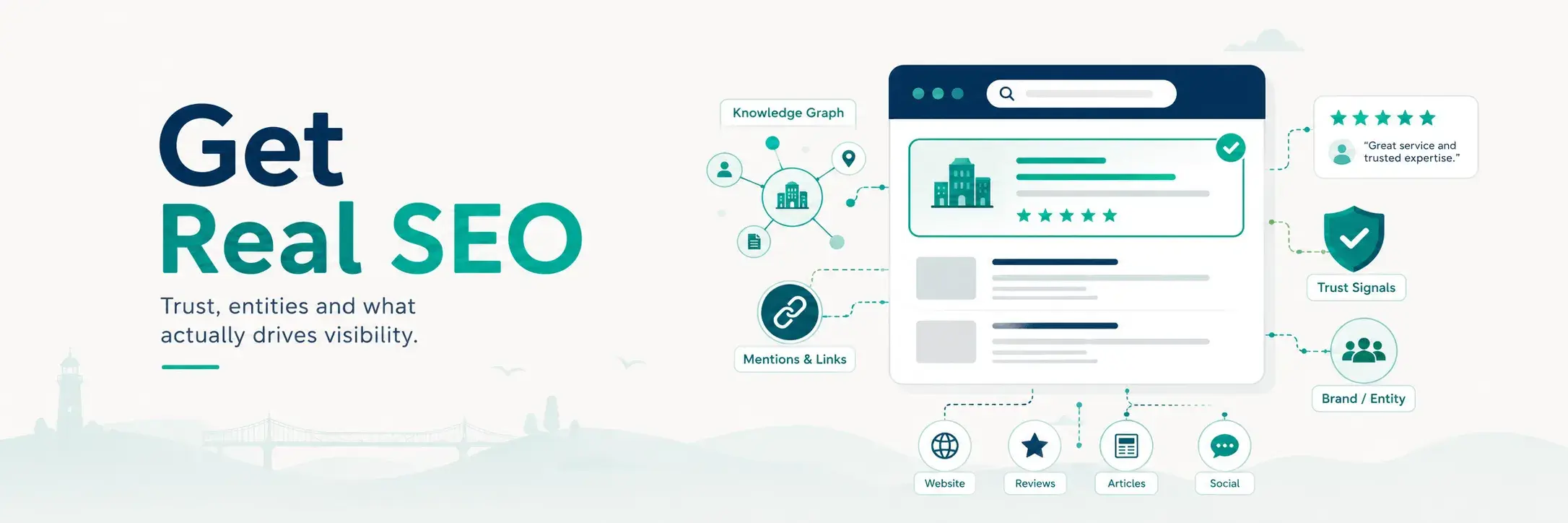
Get Real SEO
SEO changes almost every single day. There’s never a quick fix. And anyone that tells you they know the secrets that get you ranked in ChatGPT, Google and Perplexity is lying to your face. If you hadn’t already woken up to what search looks like in 2026, now’s the time to get real…
1. Is Google Confident in Your Entity?
Entity SEO. What is it and where did it come from? It’s not new, and you’ve probably already been actively doing it. The thing that’s changed is how we measure results.
Google keeps a list of every known entity in their knowledge graph. Not only does this list encompass every organisation, person, product, concept, or thing in existence, but it also comes with a confidence score. That’s the golden ticket – how confident does Google feel to serve your entity as an answer?
This all comes down to trust. Especially now German courts have ruled Google should be held responsible for the content served in their AI responses. The company is now liable for any hallucinations made by AI Mode, AI Overviews or Gemini. That’s why they want to make sure the sources these answers are being synthesised from are correct.
Fortunately, entity SEO isn’t changing the game. You simply need to provide Google with enough signals that the entity in question is a reputable source. Increase digital PR efforts, focussing on industry-specific press and encourage UGC in the form of social posts, blog comments and reviews. The more times your entity is mentioned, the stronger your entity becomes.
2. GEO/AIO/WhateverYouWantToCallItO is SEO
GEO & AIO is SEO. Let’s lose the pretence that we’re going down some radical new road. This is still search, but users are just looking in different places with more sophisticated queries.
Here’s the thing though. LinkedIn is currently swarming with opportunists claiming to be GEO experts. Do you know how LLMs like ChatGPT, Claude and Gemini retrieve information? They Google it…
(Technically they use different search engines so your SEO strategy should now include optimising for Bing and Brave instead of just focussing on Google.)
Google even came out themselves stating:
“From Google Search's perspective, optimizing for generative AI search is optimizing for the search experience, and thus still SEO.”
Don’t just take our word for it though. Bogdan Babiak from SE Ranking ran an experiment with over 2m domains. The study was to find out what influenced AI citations. Basically, he wanted to become the first actual GEO expert on LinkedIn…
Despite analysing 2,000,000 domains, Babiak didn’t find any obvious factors that led to AI Visibility growth. Do you know what he did find? Organic traffic and AI search traffic move together. That was the only correlation from his whole experiment.
So, what has changed? Honestly, very little. The AI optimisations we’re putting in place for our clients are things that would have been part of an SEO roadmap anyway, maybe with slightly more priority than before. Things like improved readability, schema-markup, topical authority, digital PR. That’s not new in our world. It’s just really f**ing good SEO.
3. Great Strategy Starts with Topical Ecosystems
If you’re not a topical expert you won’t be getting ranked or mentioned.
Gone are the days of finding keywords with high search volume and low keyword difficulty on Semrush, then whacking them into your meta title and headings to influence search results. To leave a digital footprint today, you have to become the expert.
For at least the last 8 years we’ve been talking about E-E-A-T and how important it is to build topical authority instead of optimising isolated pages. What’s changed?
Crawlers are faster now.
Query fan-out and live retrieval mean bots need a lot of questions answered in very little time. Luckily, LLM bots are much quicker than the old school Google crawlers. But now that Google is rolling out agentic AI crawlers as well, we’re about to see this become even more significant.
They’re not looking for a singular content block to answer a prompt. They’re looking to build synthesised answers from topical experts. The only way to become a topical expert is to have all the answers to all the questions. The game hasn’t changed; you’re still starting with keyword and prompt research and then creating high-quality content that’s actually useful to your audience.
What’s changed is the way you structure your strategy. Ditch starting with a keyword. In 2026, you’re starting with a topic.
Progressive SEO Insights
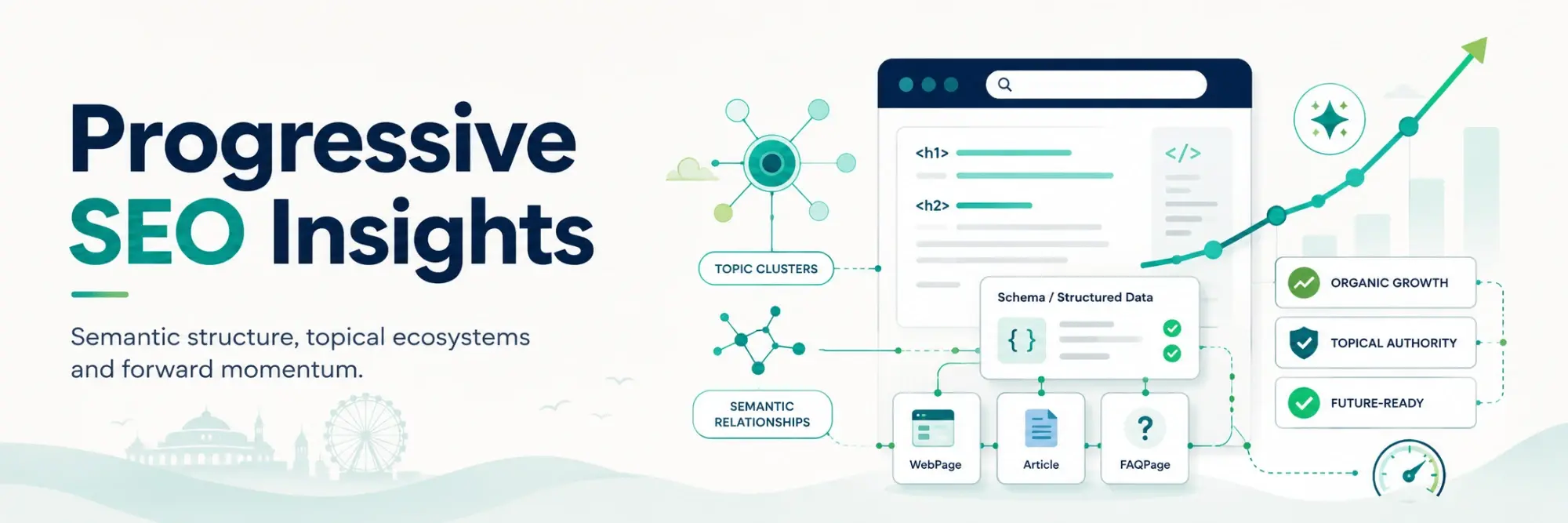
Progressive SEO is an interesting concept. The algorithms change every month. The tactics advance almost daily. Everything in the SEO space feels very progressive right now.
For our 3 progressive SEO insights, we’ve focussed on things you can start doing today to see better results from your current strategy.
1. HTML Simplicity Matters
Don’t neglect your semantic HTML. Bots are not humans (I know, we were nearly fooled). LLMs need clear signals to de-code your content and surface great content in response to user prompts and search queries.
Semantic is defined by the literal, intended meaning. Therefore, semantic HTML is used to tell crawlers exactly what the content they’re looking at is. This can be as basic as using the correct <h1>, <h2> or <h3> tags, or gets more complex when you start integrating data tables and images into your content.
The one to look out for is paragraph tags. We’re seeing more websites using line breaks (<br>) instead of proper paragraph html (<p>). This means the bots are reading an entire page of content as if it were one block of text, if they can be bothered. This is a common occurrence when text is copied and pasted from ChatGPT…
It’s not just about clean semantic HTML though. Structured data is a basic hygiene factor in 2026. And that llms.txt file you’ve been putting off is actually playing a role in both traditional and AI search.
Google Chrome is using Agentic AI to crawl now, retiring old crawlers. Agentic AI crawlers are more demanding on the site because they’re so much quicker – it’s worth checking your log files to see how this is impacting your site.
What it also means (and Google actually confirmed in their latest dev announcement) is your LLMS.txt file is critical. If you have one, it’s the first thing Google’s agentic crawlers are checking so it must be up to date. If you don’t have one, you’ll still be crawled as usual with no signs of penalties. Either way, we’d suggest getting yours created or updated as soon as possible.
2. Revenue is the Only True Measure of Search Visibility
If you’re still measuring clicks, traffic and positions to track SEO and AI Visibility performance, you’re wasting your time. Revenue is the only true measure of search visibility.
By now we’re all aware of the impact AI Overviews in search results are having on clicks. And it’s not just organic search traffic that is falling. Did you know that 93% of AI searches aren’t ending in clicks? With that in mind, can we even attribute search and AI visibility to revenue?
Absolutely.
AI search is word of mouth on steroids. Jack Lingard, Head of Search at Anything is Possible, pointed out that 47% of users have used AI to make a purchase decision. Your customers are already turning to ChatGPT, Gemini or Claude to compare you with your competitors. If we isolate mortgages as a topic, comparison intent makes up 70% of all prompts.
Decision-making is happening before the click. When the user lands on your site, whether that’s from an AI search, a social media search or an organic search, they’re already further down the funnel.
The only truth is the data we have. Track revenue from all your digital channels to see how your visibility is impacting your digital results.
3. AI Max Opens the Door to AI Mode Visibility
We’ve heard a lot of mixed opinions about the new AI Max feature in Google Ads. Despite all the research telling us switching on this magic setting will double conversions overnight, our own results have been mixed and until we got the full story at Hero Conf and latterly at Google Marketing Live (GML) we weren’t fully convinced.
Whilst everyone jumped on the ChatGPT ads bandwagon, which now has over 1,000 advertisers in the US and is beginning to reach free users in the UK, people are still being cautious about adopting AI Max.
But here’s the thing – SERPs are changing. Google users are being funnelled into AI Mode in Google’s effort to keep them in their environment. Soon, traditional SERPs will be a thing of the past. And that means traditional search campaigns as we know them will be gone too.
What you want to be doing now is getting your brand in the places that users actually are spending their time. For Google, that means AI Overviews and AI Mode. This is a double edged sword because yes, you need a great SEO strategy to increase share of voice in these spaces. But now, you can also pay for your spot at the top.
Of course, there’s a catch. There’s only one way to do it: AI audience matching. And that means AI Max or P Max. Traditional search campaigns, demand gen and display aren’t being served inside AI Mode unless the search campaign has AI Max turned on.
You need to embrace the new AI driven PPC campaign formats to be visible in AI mode and AI overviews… But not without using all applicable guardrails to sift out poor intent (more of this functionality coming soon according to Google at GML).
BrightonSEO: Your Next Steps
Appius has been successfully delivering SEO strategies for clients since 1998. SEO is part of our digital marketing services, delivered by our Experience & Insights team who are part of a full service digital agency offering.
If some of this isn't totally clear we can translate as needed, add our own experience in these areas and provide more detail on request if you contact us.
Outside of the takeaways we would love to understand your SEO training and execution needs - contact us for more information or to set up an informal chat with our SEO and digital marketing experts.

You might also like