
Building a Customer Data Platform (CDP) can be a very smart strategy; it allows organisations to gather disparate customer data sources into one place and provides a way to enhance personalisation and provide new levels of automated intelligence.
At the same time, having the wrong foundational components in place can make building a CDP an expensive distraction, turning it into a "platform of future promise" that never comes to fruition.
So, let’s ask the real question behind the Shakespearean drama. Do you actually need a CDP? Or do you need clarity, data hygiene, and a few practical integration moves first?
What People Think a Customer Data Platform Will Do
When teams ask for a CDP, they’re usually asking for one (or more) of these outcomes:
- “Give us a single customer view”.
- “Fix our data quality problems”.
- “Make segmentation and personalisation easier”.
- “Help marketing and product use the same truth”.
- “Let us orchestrate journeys across channels”.
- “Make analytics and attribution make sense”.
A Customer Data Platform (CDP) creates a unified customer database and a unified view by consolidating data from multiple sources, integrating information across all channels and touchpoints. This unified view enables real-time insights, personalised interactions, and more efficient customer service.
Unlike a Data Management Platform (DMP), which is used only for advertising and does not support marketing personalisation, a CDP is designed to unify first-party customer data for broader marketing and customer experience use cases.
Similarly, while Customer Relationship Management (CRM) systems help manage customer-facing interactions, they do not collect behavioural data on how customers interact with products or services; CDPs unify this behavioural data from multiple sources.
In summary, a CDP is software that collects and unifies first-party customer data from multiple sources to create a single, coherent view of each customer. A good CDP should provide a unified view of customer data from all relevant sources.
Those are good outcomes. The catch is: a CDP doesn’t magically do them just because it exists. It enables them, as long as the ecosystem around it is designed to take advantage.
What a Customer Data Platform Actually Is: Building Unified Customer Profiles
A customer data platform (CDP) works by collecting, harmonising, activating, and extracting insights from customer data. It consolidates data collected from multiple sources, including both online and offline channels, and integrates this information to create unified customer profiles. This enables businesses to better understand and engage their customers across all touchpoints.
At its best, a CDP does four main jobs:
- Ingests data collected from multiple sources (web, app, CRM, email, POS, support, offline channels, etc.), with data integration as a key function.
- Resolves identity (stitching behaviour and profiles into a person or household).
- Builds audiences and attributes (segments you can activate).
- Activates downstream (sending audiences/events to ad platforms, email tools, personalisation engines, analytics, etc.).
Unlike CRMs, which are primarily used for managing an individual customer's data, a Customer Data Platform (CDP) enables marketers to gain an overall picture of all customer interaction across various channels.
CDPs accept input from many different sources, including individual customer interaction data, and are often confused for either a CRM or a DMP; however, they are all considerably different in their purpose and function. Data Management Platforms (DMPs) aggregate and analyse large amounts of third-party user data in order to help advertisers target their audience(s), whereas CDPs do the same with first-party data in order to benefit from personalised advertisements to their customers.
CDPs allow businesses to consolidate the myriads of ways they collect individual customer's information into one location, where they can create a unified customer profile. By allowing customers to view their entire database of information as one cohesive unit, CDPs can significantly save marketing, sales, and customer service teams time through their lack of required manual entry into multiple resources of information.
CDPs enable businesses to create complex and robust customer profiles, find opportunities to sell customers upsell/cross-sell products and services, and create a customised experience for individual customers through personalised messaging and targeted marketing campaigns.
Through a CDP, businesses can track customer behaviour over the entire journey that the customer has made with the business.
Collecting feedback through customer surveys, forums, and social media is also possible with CDPs, which further reduce costs by allowing businesses to create an appropriate experience for anonymous visitors. By consolidating data from various channels, CDPs create a 360-degree view of customers, automate workflows, and eliminate data silos by connecting marketing tools and acting as a single source of truth.
CDPs continuously ingest new data from various sources, maintain up-to-date histories of customer interactions, and provide identity resolution by matching individual identities from different systems. They can also improve compliance with data privacy regulations such as GDPR and CCPA, and are designed to be user-friendly, allowing non-technical users to access and query customer data without IT support.
Powerful, but importantly: some stacks already do 60–80% of this without a CDP, especially if you’re using a modern CRM + marketing automation platform, a data warehouse, and decent event tracking.
Standalone CDP or Experience Platform (CMS) as CDP
A pure CDP approach is not the only way to get these benefits. We work with clients across many digital experience platforms (DXPs) that have these capabilities built in. As an accredited Optimizely agency, we’ve supported digital-first retailers and SaaS companies to build custom user profiles from interaction, conversion and experimentation data with their experience platform. This allows us to set personalisation rules directly informed by live experience data.
Sitecore already supports segmentation, scoring and orchestration using on-site behaviour data. Many B2B enterprises and professional services organisations that use Sitecore XP avoid using a separate CDP because their most valuable data is on-site behaviour, or their priority is to action the single customer view in the website as a channel.
Appius’s Sitecore experts matched 38 persona patterns for international law firm, Bird & Bird, allowing us to build personalised experiences into their website and increase thought leadership downloads. Sitecore does also have a separate CDP though, for where real time and multi-channel personalisation are key.
One of the more practical DXP/CDPs for owned digital experiences in Sitefinity Insight. Certified as one of the strongest CDPs for CMS and the web by the Customer Data Platform Institute, praised for enabling impactful customer journeys that drive business growth.
The platform captures the intent-rich behavioural data, such as journey progression and friction or drop-off points. Because all these insights remain within the platform, there is no lag between behaviour and response so insights can be actioned immediately.
Appius support Sitefinity clients with strong in-build modules and personalisation customisations using this inbuilt CDP capability.
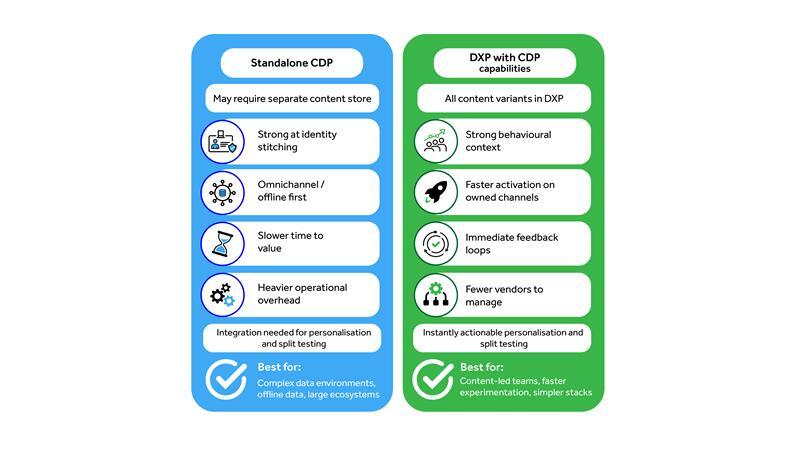
There are several benefits to a combined digital experience platform (DXP) and CDP approach:
1. Faster time to value
This CDP approach allows you to optimise experiences faster. Data collection, insight and activation happen in one place. It doesn’t need to be pushed to another system first, allowing teams to optimise experiences faster. A pure CDP approach may require months of data ingestion, mapping and governance before value appears.
2. Stronger Intent and Context
Standalone customer data platforms are best at identifying stitching and offline + online unification. However, they lack experience-level nuance such as journey stages, content consumption, friction points and interaction patterns, captured by digital experience platforms.
3. Closed-Loop Optimisations
Digital experience platforms avoid all delays between insight and execution. They enable immediate testing and learning, allowing teams to action personalisation quickly. Standalone CDPs are much slower, with feedback loops often more complex. Insights are often pushed out to other systems before you can start building actions.
4. Lower Operational Complexity
Managing a growing tech stack is one of the challenges affecting CMOs and CTOs today. By keeping your digital experience platform and your customer data platform integrated, you’re managing fewer vendors. Risk or error decreases, with less duplication of profiles and fewer sync failures. We tend to see businesses that focus on insight depth, not volume, preferring this method.
Whilst a combined DXP/CDP approach offers many benefits, businesses that require a true omnichannel orchestration would still benefit from a standalone customer data platform. If you’re business has offline operations such as retail outlets or call centres, and needs full view of online and offline customer touchpoints, a standalone customer data platform can marry this data together in a way that a DXP simply can’t.
The Three Most Common “CDP Traps” That Create Data Silos
Buying a CDP to solve a strategy problem.
If you don’t have agreed customer journeys, target segments, or use-cases, a CDP becomes a very expensive “data museum.” Lots of ingestion work, lots of dashboards, very little activation.
Failing to integrate the customer data platform properly with your broader tech stack and other marketing technologies can create data silos, which hinder collaboration and data-driven decision-making across sales, support, and marketing teams.
- Buying a CDP to solve a data foundations problem.
- If tracking is inconsistent, identifiers are messy, consent is unclear, and source systems aren’t trusted, the CDP will faithfully centralise chaos. Single customer view becomes single confusing view.
- Buying a CDP when orchestration is the real need.
Sometimes the business doesn’t need a CDP, it needs integration and orchestration, consistent event collection, a clean identity model, an event bus or middleware, and a clear activation plan.
A CDP should be integrated into the overall tech stack and work seamlessly with other marketing technologies like DMPs and CRM systems to avoid data silos and ensure unified data management. By breaking down data silos, a CDP enables better collaboration between teams, automates workflows to improve efficiency, and allows businesses to create accurate customer segments for improved targeting and personalisation.
The Better Question: What Are Your CDP Use-Cases?
A CDP is justified when it’s tied to specific, measurable use-cases. For example:
- Real-time personalisation occurring at the site-level by utilising both individual customer's behavioural activity and profile data in conjunction with existing purchase history to develop Unified Customer Profiles for more precise targeting through this approach.
- Management and Coordination of cross-channel journeys (email/SMS/ads/web/app) allow for seamless integration of multiple marketing channels when developing marketing campaigns with consistent messaging through the use of various marketing automation platforms.
- Individualised Marketing Campaigns that span the entire Customer Journey use valuable information from the Unified Customer Profiles for each targeted segment to provide customers with relevant content and offers at every point of contact.
- Fast Tracking the development of Audiences without relying on manual exports or BI Tickets.
- Connecting anonymous and known users and stitching their identities together regardless of the devices they use so that all their customer data is traceable back to the same source of truth.
- Governed Data Activation is done with the implementation of consent-based controls to ensure businesses maintain Data Privacy Compliance Regulations (GDPR and CCPA).
- AI-ready Signals (clean event data and clean user attributes) that support decisioning and automation. The result is Predictive Analytics that will allow you to track customers who may potentially churn, along with enabling you to implement proactive engagement strategies.
- Collect, Act and Retain Customer Feedback to Build Customer Loyalty and Personalisation Efforts. Composable CDPs will integrate with Cloud Data Warehouses and eliminate duplication of data between systems and reduce time and effort associated with managing data.
- CDPs act as the Systems of Intelligence for First-Party Data Management and Marketing Activation, providing business owners with critical insights that enable business growth and the ability to optimise Marketing and Customer Relationships.
When You Probably DON’T Need a CDP (Yet)
You might not need a CDP if:
- Your marketing automation/CRM already supports the segmentation you use.
- Your “single customer view” requirement is mostly service-driven (a CRM job)
- Your current systems already manage first party data and consumer data effectively, so a CDP may not add significant value.
- Identifying customers across channels and managing first party customer data are not current challenges for your business.
- Your biggest issue is web/app tracking quality, not data centralisation.
- You don’t have the team capacity to operationalise it (CDPs need operators)
- Your activation channels are limited (mostly email + basic web personalisation)
- Your customer relationship management (CRM) system is sufficient for organising customer-facing interactions, and you do not require the unified, cross-channel data aggregation that a CDP provides.
In these cases, the best move is often: fix the composable foundations first. As you evaluate the potential of a CDP, you must first formulate your objectives, choose your required features/integrations as well as define the means through which you will measure success. You should also evaluate platform scalability, review the entire cost of ownership, and verify that the CDP meets data privacy requirements (e.g., GDPR, CCPA).
Prepare the Foundations
To create a winning model of customer experience success, it’s paramount to manage customer and marketing information at every customer point of interaction. This means gathering and combining all sources of information including Email, social media, Loyalty Programs, and In-store Transactions into one 360 degree view of the customer.
To create a single view of your customer, you must also integrate your company's customer data from all customer interactions, such as customer service, with all other customer data within the organisation. This will provide a single source of truth for all aspects of the customer's interaction with your brand, allowing for enhanced personalisation, targeting and support.
You should be leveraging mobile applications to allow for a coordinated and individualised approach to automated customer experiences across multiple digital channels.
You should use customer touch points as data points for activation, learning how customers engage with your brand so you can inform your data activation strategies and improve upon your marketing efforts.
As customers are accustomed to receiving personalised, connected experiences via all of their interactions with a company or brand, it is imperative that companies are able to unify and activate their data in real-time.
1) Compositional Core (Identity + relation to customers)
- Create your customer relationship/identity model (individual, business, family unit) and rely upon resolution of the identity model to accurately relate data from multiple points of contact with the business.
- Create standard identifiers for the data collected (e-mail address, customer relationship management ID, customer ID)
- Identify and classify significant objects (status, lifecycle stage, preferences) and build a comprehensive customer profile based on first party data for the purpose of creating a complete picture of a customer.
2) Integration & Assembly
- Maintain a uniform structure for events being reported (i.e., standard event schema, event naming conventions, event governance)
- Transfer data reliably from one system to another (application programming interfaces and protocols, event streams, middleware), ensuring solid integration of data and compatibility to marketing automation systems for ease of use in creating and delivering targeted, automated marketing campaigns and efficient marketing workflows.
- Transfer the record of consent and: policy compliance with the data.
3) Automation-Readiness (i.e. AI)
- Provide clear input conditions to enable the automated process to operate with confidence.
- Develop decisioning features (propensity and intent signals, churn probability) to support valuable insight derived from predictive analytics and/or artificial intelligence techniques.
- Build in guardrails (explanation and audit functions) into all decisions made by automated systems.
4) Composable Core (Data + Identity)
- Define your customer identity model (person, account, household), ensuring identity resolution is a key function to accurately link data from multiple sources.
- Standardise key identifiers (email hash, CRM ID, customer ID)
- Establish key entities and attributes (status, lifecycle stage, preferences), focusing on building unified customer profiles from first party customer data to enable a comprehensive view of each customer.
5) Integration & Orchestration
- Establish consistent event tracking (schema, naming, governance)
- Move data reliably between systems (APIs, event streaming, middleware), ensuring robust data integration and seamless connectivity with marketing automation platforms to enable automated, targeted campaigns and efficient marketing workflows.
- Ensure consent and policy enforcement travels with the data.
- Integration with AI and Machine Learning
- Real-Time Analysis
- More Effective Marketing
6) Agentic Readiness (Yes, AI)
- Make signals clean enough for automation to trust.
- Create “actionable features” (propensity, intent signals, churn risk) and generate valuable insights through predictive analytics and machine learning.
- Put guardrails around automated decisions (explainability, auditability)
Customer Success with CDPs
The evaluation of customer success with a CDP represents a major change in how data is managed. This new way will focus on how to use dynamic management techniques to get the best results quickly and accurately through analytically actionable insights.
True power comes from combining:
- a single view of the customer;
- advanced analytical methodologies;
- real-time execution;
- and, performance capabilities.
Together, this ensures a high level of precision in evaluating individual customers' buying behaviours and reactions to promotional offers.
By using these methods collectively, we can quickly and accurately identify customer behaviour patterns at a level that we have never seen before. This allows us to find opportunities for customer engagement at the most granular level (down to specific interactions).
Our latest technical innovations allow us to map customer paths via digital touchpoints using high-resolution methods. This allows us to evaluate customer behaviours and reactions to marketing initiatives in more difficult spaces, such as micro-moments and low-engagement areas.
We can analyse the movement of customers through the purchase funnel and their conversion rates at each step along the way. These data thus inform the development of highly focused and effective marketing strategies.
Measuring CDP Success
Advanced measurement approaches that prioritise speed, precision, and quality of data are critical to realising the full potential of a Customer Data Platform (CDP). Key performance indicators (KPIs) such as customer engagement, conversion rates and customer lifetime value provide companies with the opportunity to analyse their CDP's effectiveness in driving marketing campaigns and growing their businesses like never before. Through the integration of rich customer analytics and real-time data analysis, organisations have the opportunity to develop a much greater understanding of how customer data can inform targeted marketing and create personalised experiences.
Advanced Data Management Platforms (DMPs) alter how we measure the impact of marketing on the behaviours and lifetime value of customers. DMPs shift the focus from passive post-campaign analysis to active, real-time optimisation.
At Appius, we’ve seen the power of this with Sitefinity Insight. By implementing Sitefinity personalisation, utilising user behaviour and personas, we delivered a 10% uplift in website conversions for Teachers Building Society. Not only did this project deliver better value and better results, but the intermediaries website won an award, voted by brokers themselves.
CDP Security and Compliance
As organisations gather and store larger amounts of customer information, it becomes increasingly important for them to protect this information’s integrity and confidentiality. It’s becoming increasingly important for organisations to demonstrate security and compliance when it comes to data management.
By having a comprehensive customer data platform, it is possible to guarantee that the integrity and confidentiality of this information will never be compromised by the company’s data collection or management practices. The same processes must comply with all applicable laws and regulations such as the GDPR and CCPA.
With data scientists, UX researchers and accredited CMS experts, our Experience & Engagement team are used to managing complex data challenges within large organisations. Our commitment to responsible management of third party data is a critical layer to our overall approach.
CDP Trends and Future
The evolution of our method for managing customer data has come from a migration from traditional methods to a more dynamic approach that focuses on speed, accuracy, and quality of data.
Combining traditional methods of CDM with AI and machine learning enables brands to identify how their customers are behaving (and why they behave in this manner). Additionally, dynamic customer data platforms can gain insight into previously uncharacterised low-engaged segments, or, areas in a complicated customer journey.
Brands now have access to the data acquisition process, including receiving and processing, instantly. Customer insight arrives in real-time through various channels and touchpoints.
With CDPs designed using these advanced technologies, brands can view their customer's new interactions and gain valuable insights. These insights become
actions. And these actions become results.
The use of cutting-edge data-based systems is enabling a more effective marketing approach. By targeting consumer behaviour on-the-fly, using personalisation or segmentation, marketing is speaking to the unique needs of individual users.
This is the direction marketing has been going in for some time, with programmatic digital solutions appearing across TV, radio, online and OOH. A dynamic CDP was the missing piece of the puzzle we needed to connect each user to the right message.
So ... To CDP or Not to CDP?
Choose a CDP when you need speed, scale, and governance in audience-building and cross-channel activation. A customer data platform provides a unified view of your customer data, making it easier to manage customer data from multiple sources and enabling effective cross channel marketing campaigns and personalised marketing campaigns. But first, make sure your foundations and operating model can support it.
Don’t choose a CDP (yet) when your real bottleneck is data quality, tracking consistency, unclear use-cases, or lack of activation maturity.
And if you’re unsure, the safest path is:
Start with the outcomes, design the data and orchestration layer, prove value with 2–3 use-cases, then decide whether a CDP is the right accelerator.

You might also like