This month sees the release of Targeted Support by the FCA; giving firms the ability to provide group-based recommendations to customers who have shared characteristics, without triggering the cost and complexity of fully regulated advice.
We’ve worked with several firms over the years who have up till now had to wrap their regulated advice in charged-for services. Whilst this has been a level playing field (it’s the same for everyone) – the public have missed out on easy access, low cost, or free advice that can provide a better position for their retirement.
“The choices consumers make about their pensions and investments are of the utmost importance for their financial wellbeing”
The opportunity for firms here is to embrace Targeted Support for an injection of their brand to deliver excellent service, address the ‘advice gap’, and direct the customer to chargeable advice services with better conversion.
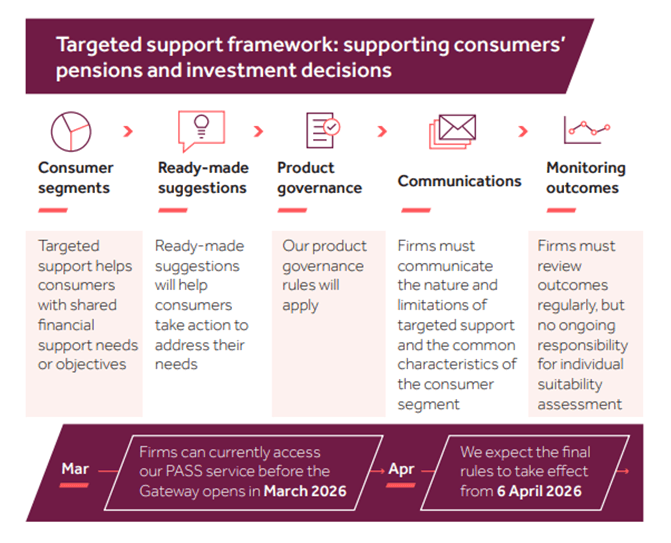
We see the new framework being an opportunity for firms to engage customers, build trust and identify intent signals (i.e ‘ready to retire in 2 years).
If ever there was a case to ensure joined-up digital journeys are in place to drive business growth, this is it.
The opportunity in detail - from static advice to always-on support
Targeted Support (TS) enables a shift from periodic, adviser-led interactions to continuous digitally enabled customer support journeys
Done well, firms can;
- Increase engagement with retirement products
- Reduce risk of poor outcomes (and regulatory exposure)
- Create new, scalable service models
- Drive conversion into higher-value advice where appropriate
Personalisation is the missing layer to unlock for a firm's Targeted Support strategy
It’s easy to think about TS as being fulfilled by segmentation, plus communication, but that’s only half the picture.
The real competitive advantage comes from how those segments experience your digital channels.
Firms already sit on rich known customer data, such as product holdings, contribution patterns, withdrawal behaviour and life-cycle indicators - all of which are insightful.
However, there is also power in the ‘unknown (or pre-known) behavioural data;
- pages viewed
- tools interacted with
- time spent on key content
- repeat visits around specific topics
When combined, these datasets enable a shift from static, one-size-fits-all journeys to dynamic, personalised website experiences that adapt in real time.
Four ways personalised Targeted Support journeys change the game
For too long, firms have relied on static communications, e.g sending an email and hoping the customer takes the next step. Targeted Support creates a very different opportunity.
The firms that get ahead won’t just communicate better, they will design experiences that respond, adapt, and guide, turning passive journeys into active decision-making moments.
Here’s what that looks like in practice:
1. Recognise context instantly
The moment a customer returns to the website, the experience reflects where they are now. Whether they’re approaching retirement, drawing down, or sitting on excess cash; content aligns immediately to their situation.
2. Let behaviour shape the journey
User experience across the website does not need to be fixed. Rather it can evolve as users engage, by adapting the experience, serving more relevant content, tools, and prompts based on what matters to them.
3. Guide with clear, contextual next steps
Instead of generic calls-to-action, leading firms can surface “next best actions” that feel timely and personal:
- ‘Explore how long your current drawdown could last’
- ‘See how others in your position are structuring withdrawals’
Instead of general prompts that are skimmed over, they are nudges that move customers forward with confidence.
4. Connect every channel into one seamless experience
Email, paid media, CRM shouldn’t operate in isolation, and each touchpoint should bring the customer back into a journey that’s already tailored to them, pre-configured to pick up exactly where they left off.
Personalisation PLUS self-serve tools paired for powerful affect
The power of TS is not just to tell customers what to consider but to allow a brand to help them understand and to act.
Appius has built many self-serve tools across a range of services (professional services, manufacturing, hospitality, and finance). Results over the years from our clients have provided compounding proof and standout ROI from investing in self-serve tools for customers.
For TS, the ideas are wide-ranging. Here are a few which we’re looking forward to exploring and realising with our clients.
Examples of high-impact self-serve tools:
- Retirement income simulators
- Drawdown sustainability checkers
- “What if” scenario modelling tools
- Guided decision journeys (not full advice)
- Personalised dashboards highlighting risks and opportunities
The power unlocked from embedding these tools intelligently into personalised customer journeys is obvious.
We’re looking to partner with firms ready to use the TS framework as a competitive edge; driving higher engagement, improved completion, and richer behavioural insight. Is that you?

You might also like